


Maria Trost Mission was started in 1895 as an outstation between Oetting and Maris Stella. Named after a shrine in Graz, Austria, the present stone building is the third, built in 1934. The mission, started by the Trappists, has several substantial barns and residences. In the adjacent graveyard I found the solitary grave of Trooper Kenneth George Cooper of the Natal Mounted Police, who died on 10 October 1901. (See below)
81 Photos
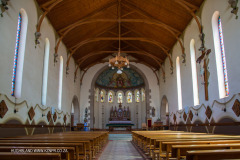
In 1893, Brother Nivard Streicher, using an agent bought three farms in the Ongeluksnek Valley. The brothers left Lourdes in 1894 to commence their work. Mariazell was named after a shrine in Europe. As was usual local stone was used for the school and a convent built in 1900. The present church was on constructed in 1916 and is unique in its beauty. The monastery was built in 1938. The workshops were built to take advantage of the plentiful water and to this day the water is gravity fed down to the turbines to supply power to the mission and the mill and workshops. Many of the old tools are still used in the workshop and the mill is still in good condition.
121 Photos
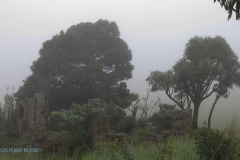
A while ago I photographed the remains of this old church and wondered about its origins. Whilst visiting the Garrison Church in PMB, I met Earle Larson, who enlightened me and sent the old image of the church. (See below). Alongside are images I took and some of the few remaining graves. This church was built on the farm Mount Pleasant at a cost of 800 pounds, and consecrated on October 1903 by the Bishop of Natal, the Right Revered Samuel Baines. The locals had until that time worshiped at the Mooi River ,St Johns church, but wanted their own church closer to their own community. This small church of 90 square metres was nearly destroyed in a snow blizzard in in May 1905, bur rebuilt by August of the same year. St Mary’s was used until 1940, when it was closed down due to a diminishing congregation, and sold to a private farmer. Parts of the church were salvaged and used to build St Mary’s in Bruntville, and the font given to a church in Greytown. Ref: Earle Larson A few graves remain on the site and are shown here. The site was overgrown and more graves may exist.
33 Photos
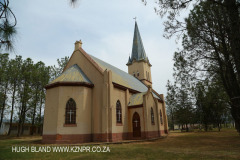
This album has images of the Loskop Railway Station and trading stores, and the near-bye small industrial area. The main focus is however on the Empangweni - Moorleigh Mission, which was established in 1863 by Missionary Heinrich Kayser . The buildings shown here comprise The Mission Press (1909), St Johanneskirche (1908) and the Gnadenkirche (1911), which were built by these German Lutheran missionaries. The Mission is also the site of two schools and two cemeteries related to the two churches.
117 Photos

Mount Pleasant is located off the Richmond Road near Manderston and consists of an old trading store and a family church on a Farm called \"New Leeds\", belonging to the Stead family. The small church and family cemetery are unfortunately a little neglected. The farm was settled by Mathew & Mary Stead who came with the Byrne Settlers in 1850,but after 5 years moved on to New Leads from Byrne. The church and graveyard is testimony to the family and following generations including Thomas and Susan who came out in 1861,together with his father, Benjamin and brother Samuel. Other graves in the cemetery include those of the Thompson\'s,Cunningham\'s,Grist,Douglas and Pellews.
36 Photos

This album has two Temples and a church in the Mount Edgecombe area in close proximity to the old sugar mill. Included are images of the St Joseph's Catholic Church, Shree Ganesha, Siva Soobramoniar and Shri Mariamenn Temples.
85 Photos

This church overlooking the Mtwalume River and between Umzinto & Highflats has graves of many of the local families. Some of those buried here are from families such as the Chicks, Hamiltons, Arnotts, Ushers, Cross, Oldfield and Walkers.
47 Photos
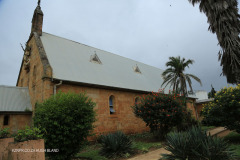
St Michaels Trappist Mission is about 10 km north of the main Umzinto - Highflats road, at the village of Njane. This mission deep in the valley is one of the more than 20 Missions built by Francis Pfanner and his monks from Marrianhill. This particular mission has a school and two churches or monastries.
59 Photos

Otting Trappist Mission in southern Natal, near Highflats, is one of the many Mission Stations built by Francs Pfanner after he established Mariannhill Monastrty in1882. The Missions were set up so as to be no more than a one day horse ride in between. This album has images of the Mission Church, its outbuildings, grounds and of the interior of the Church.
131 Photos
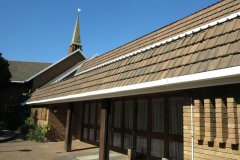
This gallery has images of two old churches in Pinetown, namely Christ Church in Meller Road and Church of St John the Baptist in St Johns Road. The latter church has a large civilian and military graveyard. The military graves are in a separate album under the Military interest Gallery. The graves in St Johns include many of the old Pinetown families many of who\'s names are seen in the area. Some of the families are the Bousefields, Davidson\'s,Fields, Hill, Downs and Norgate. There are also images of the NGK in St Johns & Paynes avenue.
61 Photos
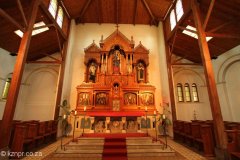
The Mariannhill Monastery near Pinetown was established in 1882 by the Trappist Order of Monks led by Prior Wendelin (Francis) Pfanner and 31 volunteers. This Abbey was the \"mother\" of the 22 other Monasterys established around KZN , like Reichenau, Centocow and Lourdes. To give some idea of the size of Mariannhill, in 1906 it had 320 Monks and 275 sisters in its services. This gallery has images of the Cathedrals, churches, and all the support buildings built in the local red brick made on site. There is also the St Francis college and St Mary\'s hospital, workshops and tea garden. In the cemetery are also graves of soldiers who died in the Boer war hospital located here at the time.
647 Photos

Fort Napier was established as a garrison in 1843, and for many years utilized a makeshift church or their Drill Hall. Pressure was applied to build a church for the garrison, and a new church was duly designed by architects Methven and Pentland-Smith. In 1897 the foundation stone was laid by Mrs Cox, wife of the Commanding Officer of the troops, and the first service held on 9 October 1898. The name St Georges was used as St George is the patron saint of soldiers. The church nave is 94 ft by 44 ft, and the church built of Maritzburg red brick. The church was used as a hospital during the Boer War with 427 patients both from the forces and the nearby Concentration Camp. The church continued to be used by the military until 1914 when the last of the Imperial troops, the 1st South Staffordshires, departed for Ypres. Over the years the congregation declined as Fort Napier was converted to a mental hospital, and the downtown CBD lost its congregants. Local schools like Wykeham, and Maritzberg College continued to use the church until either building their own or relocating. The church has much memorabilia, seen in this gallery, including military related plaques, the hand carved pulpit, the sanctuary reredos commemorating the units who worshiped here, and the organ built by local organ builder William Kemp. One of the organists, Willie Poole was to play this organ for 71 years. Ref: T.B.(Jack) Frost - 1998 - St George's Garrison Church 1898 - 1998 - A Brief History.
126 Photos

Named the Church of Madonna delle Gracie (Our Lady of Mercy), the tiny church in Epworth, Pietermaritzburg, built by Italian prisoners of war can accommodate about 50 worshippers. This marvel of engineering using limited materials fell into a state of disrepair before being restored. The first group of 5 000 Italian combatants captured by South African forces in East and North Africa arrived in the camp in 1941 and were at first housed in tents before being moved into wooden dormitories. Early in 1942 the camp chaplain, Padre Giacomo Conte, suggested that artisans among the prisoners should build a church in the camp grounds to relieve their boredom. The shale blocks had to be quarried 2km away, then hauled to the building site by human muscle-power using makeshift carts. The Italians began work on the church on February 2, 1942, after Sergeant Ottaviano Ariello, an architect, drew the plans and acted as building supervisor. It is only 17.3m long and 7.5m wide with a clock tower 9.5m high. The cornice over the main entrance bears the inscription: MATRI DIVINAE GRATIAE CAPTIVI ITALICI AD MCMXLIV. The ceremony of inauguration, consecration and a pontifical mass was performed on Sunday, March 19, 1944, by the Apostolic Delegate, Archbishop Van Gijlswijk, when he officially named the building the Church of Madonna delle Grazie (Our Lady of Mercy). For the remaining months of the war, services were held regularly, but when the war ended the camp was disbanded, the prisoners were repatriated and the church stood alone by the roadside, forgotten and neglected. The building and a sculpted stone lion in the churchyard could be seen from the N3 highway and, in the 1950s and 1960s, it was often occupied by tramps and vagrants who vandalised the interior. Father Anton Dovigo was on holiday in South Africa from Italy in 1962 when he visited the diminutive church and was so shocked at its awful condition that he launched a fund for its restoration. Former prisoners in Italy and South Africa contributed to the fund and local builders donated their time and expertise for its restoration. A new bell was cast in Italy and sent free of charge to Durban. When it arrived in Epworth, former prisoner Salvatore Fardella, who helped build the church, installed the bell in the tower. One of the memorials in the cemetery of the Italian POW Church in Pietermaritzburg commemorates Italians who died when a German U-boat mistakenly sank a British troop carrier, the SS Nova Scotia, on November 28, 1942. The ship sailed from Massawa in Italian East Africa with 765 Italian prisoners-of-war, 134 British and South African soldiers and 110 crew. It was heading for Durban when it was torpedoed 40km off the Zululand coast and blew up within 10 minutes. Realising the submarine captain’s error, the German U-boat command notified the Portuguese authorities in Mozambique and a rescue ship was sent from Lourenco Marques (Maputo). The Alfonso du Albuquerque reached the scene next day, rescued 192 survivors and took them to Mozambique. An estimated 645 Italians died in the sinking, with many bodies washed onto Natal’s beaches. The remains of 120 victims were laid to rest in the Italian military cemetery in Hillary, Durban, before being re-interred in Pietermaritzburg in 2008. Ref: Sunday Tribune 23 Oct 2016 - Richard Rhys Jones.
87 Photos
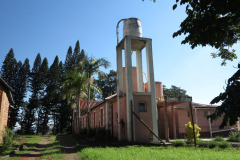
St Faiths - Maris Stella, to the North West of Port Shepstone is one of the many Trappist Missions established by Francis Pfanner in the late 1800's and early 1900's. This Mission comprises the chapel and also has a small school associated with it which was established in 1909. All of these Missions fell under the control of the "mother" mission established at Marrianhill.
124 Photos
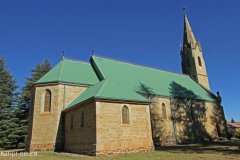
Riechenau Trappist Mission, near Underberg was established in 1886 as a daughter mission to the Marrianhill Monastery near Pinetown started by Abbot Francis Pfanner. The Mission is now a school catering for pupils from underprivileged homes. The Mission which is open to visitors(for a small fee ) has a functioning mill on the Polela River, boarding houses, formerly the Brothers and Sisters Convents, farm buildings, and a cemetery . The centrepiece is however the beautiful church, with ornate murals and stain glass windows.
325 Photos

St Mary's Anglican Church was consecrated in 1856 and is the oldest Anglican Church in Natal. Many of the Byrne settlers brought out are buried in the cemetery. This album has many images of the church and of the graves in the cemetery.
116 Photos

Charles Johnson (1850 - 1927), built the St Augustine's Mission, where he operated as a doctor and dentist to the local Zulu communities. The foundation stone of the mission church was laid in 1898 by Bishop Carter but was delayed by the Boer War and completed in 1903 at a cost of GBP7000. The sandstone church has a nave of 100ft and 60ft wide, a chancel 60ft by 40ft and the clerestory held up by two rows of pillars, 32 feet in height.(Lee A.W. "Charles Johson of Zululand" 1930. Charles Johnson is buried within the walls of the church. A considerable number of structures were subsequently built that became accomodation, hospitals and places of leaning. Sadly most of the structures are derelict.
104 Photos
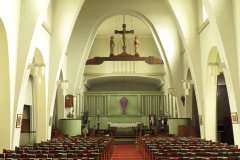
St Cyprians Anglican Church founded in 1867 is presently in Umbilo Road. The church has majestic arches and many stain glass windows adding to its beauty. The interior has plaques commemorating the Soldiers who died in the Boer War from the Natal Naval Corps and commemorations to its past serving clergy. The Church was originally established in 1867 based in Pine Terrace which was to become Commercial Road. In 1877 the Foundation Stone was laid for the new Smith Street Church (410 - 416 Smith Street)on the site of the present day Hub. In 1939 the church moved to Congella and in 1940 the present Church was opened and the Parish Hall in 1954. The Garden of Remembrance was established in 1960.
64 Photos

Centocow (Czestochowa) was founded in 1888 by Abbot Francis Pfanner on the banks of the Umzimkulu River near Creighton, with funds donated by a Polish princess. Centocow formed one of the satellite missions under the umbrella of the Marrianhill Monastery. The first church was built in 1892 and is now a gallery & Museum. Due to the growth of the congregation a second church dedicated to the Sacred Heart was built, starting in October 1910 and completed in December 1913. In 1936 a hospital was built and named St Apollinaris named after the parish priest Father Apollinaris Schwamberger. Centocow in 1954 became part of the Umzimkulu diocese and the Marrianhill brothers and sisters left. This album has images of the Churches, residences, hospital and support structures built over the inter leading years.
204 Photos
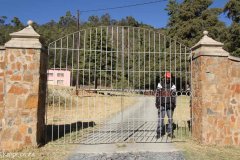
Abbot Francis Pfanner who founded Marrianhill Mission in 1882, established Emaus Mission in 1884 and spent the last 15 years of his life here when he died in 1909. The house he built in 1904 and his life is commemorated on a plaque.
55 Photos